


For many people, life insurance starts out as a way to protect a paycheck, something that steps in if you're no longer there to provide for the people who depend on you. As you get closer to retirement, that role can change. The mortgage may be paid off. The kids may be independent. The question shifts from "What happens to my income?" to "What happens to what I've built?"
That shift is easy to overlook, especially if a policy has been sitting untouched for years. But a policy purchased in your 30s or 40s was designed to solve a different problem than the one you may be facing today. Reviewing your coverage as you approach retirement can help you confirm it's still doing the job you actually need it to do.
This guide walks through how the purpose of life insurance tends to evolve near retirement, what to look for in different policy types, and where coverage can fit into a broader retirement and legacy plan.
Key Takeaways
Coverage needs change over time. Life insurance purchased for income replacement earlier in life may no longer match your goals once you're approaching retirement.
Liquidity matters. A policy can provide funds exactly when they're needed, potentially helping you avoid selling investments during a market downturn.
Policy type affects fit. Term, whole life, guaranteed universal life, and survivorship policies each serve different purposes, and there's no single right answer for everyone.
Ownership structure can affect taxes. How a policy is owned may determine whether proceeds are included in your taxable estate.
Older policies may need a second look. Contracts issued decades ago may carry outdated assumptions that no longer reflect current interest rates or costs.
Coordination is key. Life insurance generally works best when it's reviewed alongside your broader estate, income, and legacy plans, not in isolation.
How Does the Purpose of Life Insurance Change as You Approach Retirement?
Early in life, coverage is often centered on replacing income for a spouse or children. As retirement nears, that need can decrease as debts shrink and dependents become self-sufficient. At the same time, new priorities may emerge, such as offsetting potential estate taxes, supplementing retirement income for a surviving spouse, or supporting a charitable cause.
Understanding how these priorities shift can help you evaluate whether your current coverage still lines up with your goals, rather than simply continuing a policy out of habit.
How Does Life Insurance Actually Work Near Retirement?
At its core, life insurance is designed to convert regular premiums into a pool of funds that becomes available when it's needed most. For those approaching or in retirement, that can look like:
Helping avoid forced asset sales. Coverage may reduce the need to draw from investments during a market downturn.
Bridging a pension gap. A policy can help replace income from a pension that ends at death.
Offering tax-efficient liquidity. Death benefits are generally income-tax-free under current federal law.¹
Supporting charitable goals. A modest premium may help fund a meaningful gift through a nonprofit beneficiary designation.
If it's been a while since your policy was reviewed, this can be a good time to confirm it still supports where you are today. Contact WealthPartners to talk through whether your current coverage still fits your retirement goals.
Which Type of Policy Fits Your Retirement Goals?
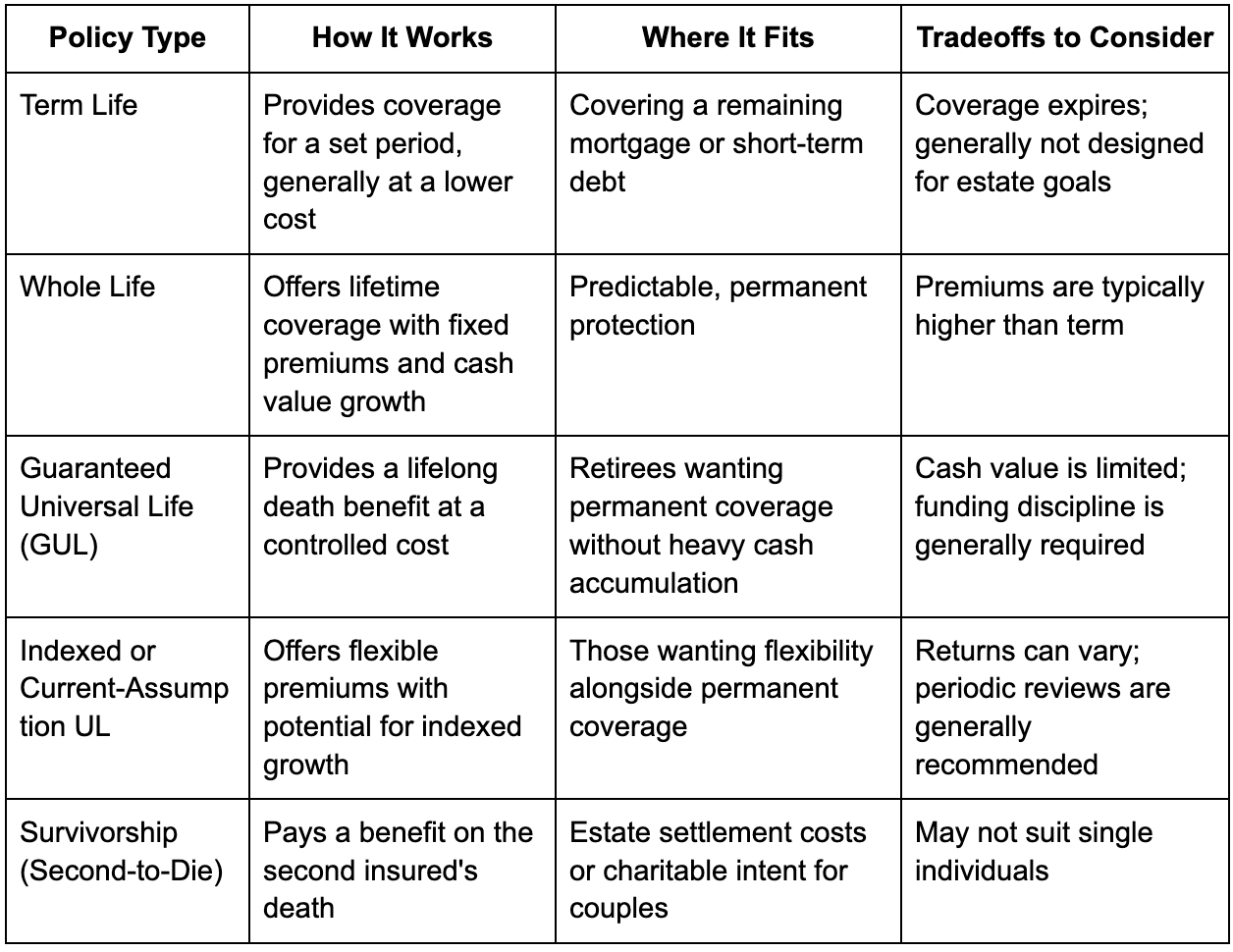
Different policy types are generally built to serve different purposes. The table below outlines how common options tend to work and where they may fit.
Policy fit tends to reflect your broader financial and family picture. A few examples of how this can play out:
Single with charitable goals: A smaller permanent policy may help create a lasting gift at a relatively modest cost.
Married with a pension ending at death: Permanent coverage can help secure income for a surviving spouse.
Business owner nearing a sale: Coverage may help fund a buy-sell agreement or equalize proceeds among heirs.
Household with significant real estate holdings: Survivorship coverage may help prevent a forced sale to cover estate taxes.
Couple concerned about long-term care: Hybrid life and long-term care policies may offer added flexibility.
Because every situation is different, it's worth connecting with your financial professional to talk through which structure may make the most sense for you.
What Hidden Factors Can Affect Your Policy's Outcome?
Tax treatment, ownership structure, and policy design can all influence whether a policy ultimately serves its intended purpose. A few factors worth understanding:
Ownership and estate inclusion. If you retain what's known as "incidents of ownership," death proceeds may be included in your taxable estate.² An irrevocable life insurance trust (ILIT) is one tool that may help address this, and your attorney can advise on whether it fits your situation.
Modified Endowment Contract (MEC) status. Overfunding a policy can change how loans and withdrawals are taxed.
Transfer-for-value rule. Selling or assigning a policy may reduce or eliminate the income-tax exclusion that otherwise applies to proceeds.
Policy performance risk. Interest-sensitive contracts may benefit from periodic stress-testing, particularly in lower-rate environments.
Older policies, particularly those issued in the 1980s or 1990s, were often built around assumptions that no longer hold up. A review may reveal that cash values or guarantees are weaker than originally projected. Ask your financial professional to take a look at any older policies you're still carrying.
How Can You Integrate Life Insurance Into Your Retirement and Legacy Plan?
Coverage tends to work best when it's coordinated with the rest of your plan rather than treated as a standalone product. A few steps that can help:
Clarify your intent. Decide what you want the policy to accomplish: income continuity, estate liquidity, or a charitable gift.
Coordinate beneficiaries and ownership. Keep documentation current to reflect trusts, remarriage, or adult children.
Assess funding levels. Confirm projected values can sustain coverage for as long as you expect to need it.
Align with your estate plan. Make sure policy terms work together with your will and any trust structures.
Review regularly. Changes in the market, interest rates, or tax law can affect whether a policy still fits.
A Quick Checklist for Reviewing Your Coverage
Confirm your current beneficiary designations are accurate and up to date
Review who owns the policy and how that may affect estate inclusion
Compare your policy's current cash value and guarantees against original projections
Check whether your coverage amount still matches your current goals
Ask whether a Section 1035 exchange could improve an older contract
Talk with your attorney about whether an ILIT may be appropriate for your situation
Schedule a policy review with your financial professional at least every three to five years
Common Mistakes to Avoid When Reassessing Your Coverage
Letting a policy run on autopilot. Coverage purchased decades ago may no longer reflect your current goals or family situation.
Overlooking ownership details. Who owns the policy can matter as much as who's insured, particularly for estate tax purposes.
Assuming all permanent policies work the same way. GUL, whole life, and indexed UL each carry different tradeoffs worth understanding.
Skipping a professional review of older contracts. Interest rate assumptions from decades past may no longer hold up.
Treating life insurance as separate from your estate plan. Coverage generally works best when it's coordinated with your will, trusts, and income strategy.
Frequently Asked Questions
Does the purpose of life insurance change once the mortgage is paid off?For many retirees, yes. Coverage can shift from income protection toward wealth transfer, estate liquidity, charitable giving, and tax-efficient asset distribution.
Which policy types tend to fit legacy and estate planning goals? Permanent policies, including whole life, guaranteed universal life, and survivorship life, are generally designed to offer lifetime protection and a predictable death benefit, which can support estate and legacy goals.
How does tax law affect life insurance for retirees?Under current federal law, death benefits are generally income-tax-free.¹ That said, policy loans, withdrawals, or certain transfers may trigger a taxable event, so it's worth discussing your specific policy with your tax professional.
Can an older policy be updated or replaced?In some cases, a Section 1035 exchange may allow you to replace or update a contract without triggering taxes.³ Whether this makes sense depends on your specific policy and goals, and your financial professional can help you evaluate the option.
How does policy ownership affect estate planning?Ownership can determine whether proceeds are included in your taxable estate.² Transferring ownership or using a trust, such as an ILIT, may help manage that exposure, though this should be discussed with your attorney.
How often should coverage be reviewed?Generally, every three to five years, or sooner after a major life or tax change, can help keep your coverage aligned with your current goals.
Is life insurance still useful once dependents no longer need income protection?Often, yes, though the role tends to shift. Coverage can become a tool for estate liquidity, charitable giving, or supporting a surviving spouse rather than replacing lost income.
Ready to Reassess Your Coverage?
As retirement gets closer, the role of life insurance often shifts, from protecting dependents to supporting stability, tax efficiency, and long-term intent. A few things worth keeping in mind:
Coverage needs generally change as debts shrink and dependents become independent
Policy type, ownership structure, and funding level can all affect whether a policy still fits your goals
Older contracts may carry outdated assumptions worth reviewing
Life insurance tends to work best when coordinated with your broader estate and income plan
If it's been a few years since your policy was reviewed, now may be a good time. Contact WealthPartners to schedule a conversation about whether your current coverage still reflects your goals for this stage of life.
¹ Internal Revenue Code §101, Exclusion of Death Benefits: https://www.law.cornell.edu/uscode/text/26/101 ² Internal Revenue Code §2042, Estate Inclusion of Life Insurance Proceeds: https://www.law.cornell.edu/uscode/text/26/2042 ³ IRS, Like-Kind Exchanges of Insurance Policies (Section 1035): https://www.irs.gov/
This content is developed from sources believed to be providing accurate information. The information in this material is not intended as tax or legal advice. Please consult legal or tax professionals for specific information regarding your individual situation.
Securities offered through Kestra Investment Services, LLC, member FINRA/SIPC (Kestra IS). Investment advisory services offered through Kestra Advisory Services, LLC (Kestra AS). WealthPartners, Bluespring Wealth Partners, LLC, Kestra IS and Kestra AS are affiliated through common ownership by Kestra Holdings. WealthPartners is a member of PartnersFinancial. Kestra IS and Kestra AS are not affiliated with PartnersFinancial.
Kestra AS and Kestra IS do not provide tax or legal advice and are not Certified Public Accounting (CPA) firms.