


Retirement can bring new medical, family, and financial realities, which is why a living will can be so valuable. A living will records what you want, and what you do not want, if a serious illness leaves you unable to communicate, helping your care team and loved ones act with clarity.
To handle the gray areas, name a healthcare agent, the person legally appointed to make medical decisions if you cannot. Paired with a living will, this keeps your choices aligned with your values, reduces confusion during crises, and supports a sensible use of time and money. Here is what to know before you put it all in place.
Key Takeaways
A living will can ease decision-making during a medical crisis; it works best when coordinated with a healthcare agent and reviewed regularly. Here are some key points to understand.
A living will documents medical treatment preferences for times when you cannot speak for yourself.
Clear instructions can reduce family conflict and help clinicians act with confidence.
Documents that are too vague, or too specific, can create uncertainty at the bedside.
A living will is most effective when paired with a medical power of attorney and shared widely.
Regular reviews, especially after health or life changes, help keep your wishes current.
Used wisely, a living will supports dignity, comfort, and family harmony. The sections that follow explain how to prepare, coordinate, and maintain this document in retirement.
What Is a Living Will, And How Does It Fit With Other Estate Documents?
A living will is a legal directive that details your medical treatment preferences should you become unable to make decisions independently. It typically addresses resuscitation, mechanical ventilation, and artificial nutrition or hydration, guiding care to reflect your values and preferences rather than predicting every scenario.
A medical power of attorney, or healthcare proxy, names someone to decide when the document does not cover a situation. Many states bundle both into an advance directive, which simplifies completion and storage.
Together, these tools provide direction and decision-making authority, which is crucial in these situations, since they can be highly complex and emotionally charged.
Advantages Of Having A Living Will
Retirees often juggle multiple specialists while family lives far apart, and silence breeds uncertainty that leads to conflict and delay. A living will sets clear treatment boundaries so clinicians can act confidently and families can support one another, and that clarity can also prevent unwanted, costly interventions that add little comfort or meaning.
Clarity During Health Crises
When emergencies unfold quickly, a living will provides a roadmap for clinicians and loved ones. Clear preferences help avoid hesitation, reduce conflicting opinions, and channel focus toward what matters most to you.
Reduced Emotional Burden On Loved Ones
Families often struggle with questions like, “What would Mom want?” A concise document can help lower the emotional temperature, which can prevent disagreements and ease feelings of guilt after difficult choices.
Administrative Ease And Care Coordination
Hospitals, skilled nursing facilities, and hospice programs frequently ask for advance directives at admission. Having your living will on file can streamline transfers and decrease the chance of repeated forms, missed uploads, or delays that complicate care.
Financial Awareness In Retirement
Your preferences influence the intensity and setting of care, which can affect out-of-pocket costs, travel for adult children, and the need for paid caregiving. While no document guarantees lower expenses, avoiding unwanted interventions can help align spending with your priorities.
Alignment With Personal Values
Some retirees emphasize comfort and time at home, while others want all possible measures for a defined trial period. A living will allows you to record those values in plain language, and then share them with the people who will advocate for you.
Drawbacks And Limitations To Weigh Carefully
A thoughtful document cannot anticipate every clinical twist, nor can it override state law or a facility’s policies. Some forms use broad statements that may be hard to apply at the bedside, while others may list scenarios so narrowly that they miss what actually happens during complex illnesses.
Preferences can change as health changes, and contact information or agent availability can change as well. These limits are not reasons to avoid planning; they are reasons to plan with eyes open and to schedule periodic reviews.
Over Or Under Specificity
If a document is too general, it can be hard to apply. If it is too narrow, it can miss real-world circumstances, such as new treatments or layered conditions. Aim for statements that express goals and boundaries, then let your healthcare agent interpret the gray areas.
Out Of Date Instructions
Medical standards and personal preferences typically evolve over time. A document signed years ago may no longer reflect current wishes or contact information. Periodic reviews and updates can help decrease the risk of surprises.
Variations In Recognition And Application
Facilities and clinicians interpret documents in accordance with the law and their policies. A clear living will is helpful, yet it cannot anticipate every institutional rule or emergency context. Pairing it with a healthcare agent can help bridge the gaps.
False Sense Of Completeness
A living will does not replace conversation. Without talking through values and tradeoffs, loved ones may still feel unsure. Discussion now, even a brief one, can give your instructions context that is invaluable later.
Comparison: Living Will, Medical Power Of Attorney, And Combined Advance Directive
The table below shows how each tool functions, when it applies, and where limitations arise. Use this side-by-side to confirm which documents you have and where you may want to add support.
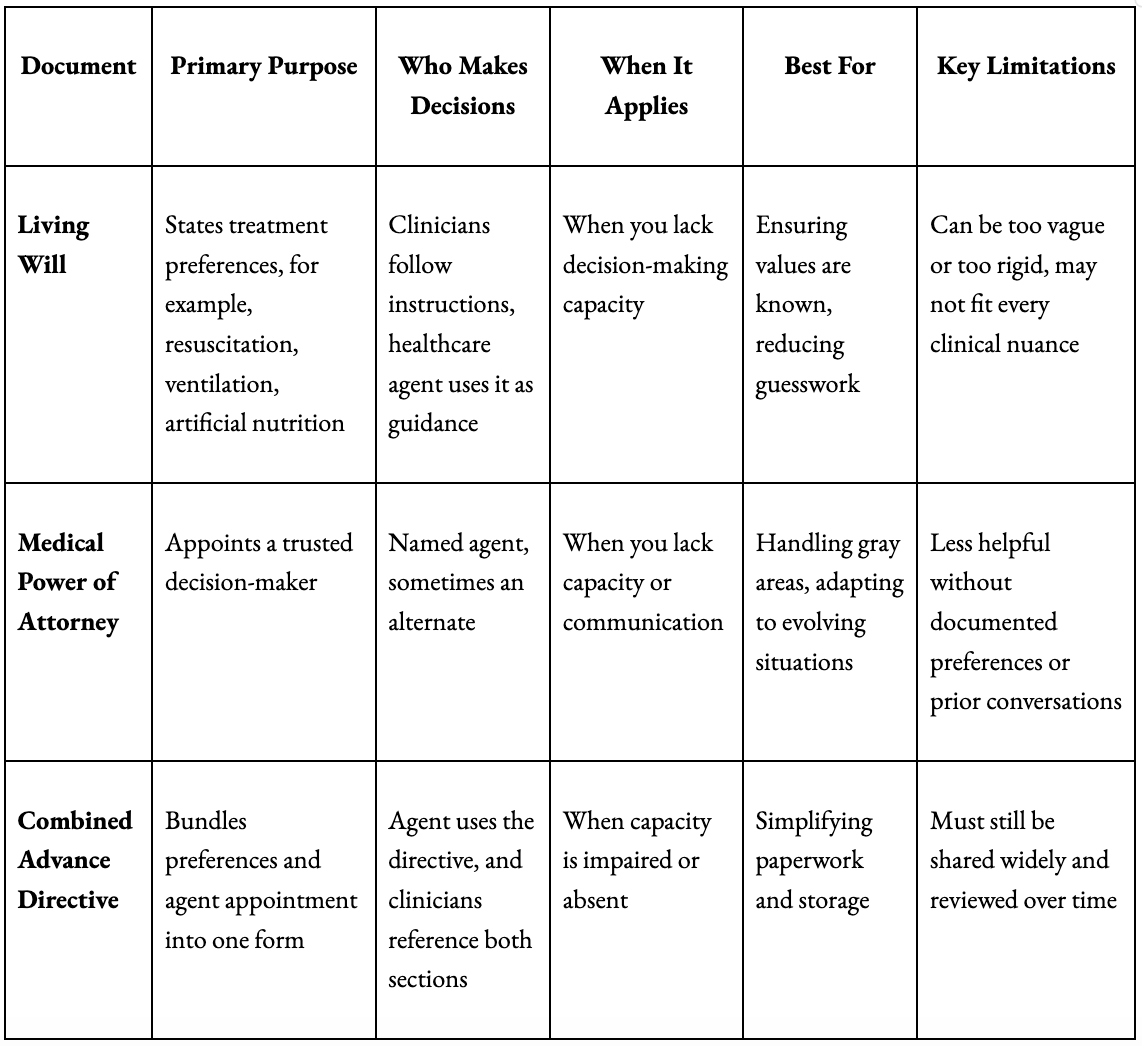
These tools typically should be complementary. If you already have one, consider whether adding the others would make real-world decisions smoother for your family and care team.
How To Make A Living Will: Practical Steps
A plan is only as strong as its real-world usability. Lead with values, such as comfort, time at home, or a time-limited trial of aggressive treatment. Pair the document with a capable healthcare agent, and place current copies in patient portals and at admissions desks. Keep a copy visible at home or on your phone, so your wishes can be accessed quickly and easily when needed.
Capture Your Values, Then Write Clear Instructions: State two or three priorities, for example, comfort, independence, time at home, or a trial of aggressive treatment with reassessment, and turn them into plain-language guidance clinicians can apply.
Appoint and Brief a Healthcare Agent: Choose someone steady under pressure, share your living will, confirm willingness to serve, and exchange current contact information.
Make the Document Usable and Keep It Current: Store the original in a known spot, share copies, upload to patient portals, store a copy on your phone, and review every two or three years or after key events such as a new diagnosis, hospitalization or surgery, a move, the loss of a spouse or caregiver change, or your annual Medicare visit.
Review your living will every two or three years, or whenever your health, residence, or decision-makers change. For help, contact the office.
Where A Living Will Intersects With Retirement Finances
Medical choices shape where, when, and how long care happens, which in turn can affect costs, logistics, and caregiver needs. Home-focused comfort care may shift spending to in-home support, while hospital-focused care often brings facility copays and increased transportation. Clear plans, within insurance limits, can reduce repeat visits, duplicate tests, and last-minute scrambling. When the family understands your wishes, they can coordinate travel and time off more efficiently, which can lessen the need for urgent paid help.
Cash Flow Awareness
Treatment choices can influence whether care occurs at home, in a hospital, or in a skilled nursing facility. Each setting carries different copays, transportation needs, and caregiver demands. Aligning preferences with expected costs can protect cash flow and reduce last-minute financial strain.
Insurance And Timing Realities
Clear preferences can shorten administrative back-and-forth, which sometimes reduces delays or duplicate services. While outcomes vary, better coordination often means fewer unpleasant surprises for fixed budgets.
Family Logistics
When wishes are documented and shared, adult children can plan travel, time off work, and caregiving rotations with more confidence. That planning can reduce burnout and the need for urgent paid help.
Practical Setup: Creating, Storing, And Updating
Completing a living will can be more straightforward than many people expect, and there are several credible paths. State forms are widely accepted, attorney-drafted documents allow customization for complex families, and many health systems offer packets that combine preferences with agent designation.
Once signed, version control and access matter as much as the content, which means labeling files clearly, replacing old copies, and confirming that your doctor and preferred hospital have the latest version. Reviews tied to life events can keep instructions accurate and agents reachable.
Document Creation Options
State-provided forms are widely accepted and straightforward. Attorney-drafted documents can offer customization, especially for complex family dynamics. Many healthcare systems also provide integrated advance directive packets that combine a living will and healthcare agent designation.
Storage And Sharing
Keep one signed original living will, then distribute copies to your agent, alternates, and primary clinicians. Label digital files clearly, for example, “LivingWill_LastName_YYYY,” and store them in a secure cloud folder that your family can access if needed.
Periodic Reviews
During a review, confirm that contact details for your agents are current, that preferences still reflect your values, and that copies in your medical records match the latest version. If changes are needed, sign and date the new version, and ask recipients to replace prior copies.
Frequently Asked Questions About Living Wills In Retirement
It is normal to have questions, especially when health, family, and finances intersect. The answers below offer general education so you can take the next step with confidence.
Is A Living Will The Same As An Advance Directive?
Not always. In many states, a living will states preferences, while an advance directive may bundle those preferences with a healthcare agent designation. Review your state forms to see how the terms are used where you live.
If I Name A Healthcare Agent, Do I Still Need A Living Will?
Yes, in most cases, the two work well together. Your agent handles the gray areas, and your living will provides guardrails and values that guide their decisions.
How Often Should I Update My Living Will In Retirement?
Consider a review every two or three years, and after major life or health events. Even small updates, for example, an address or phone number, help documents work when needed.
What Happens If My Living Will Conflicts With My Family’s Wishes?
Clinicians generally look to your documented preferences and your healthcare agent. Early conversations reduce the chance of conflict and help your family understand the reasons behind your choices.
Final Thoughts and Next Steps
A living will can help clarify care preferences and lighten the burden on loved ones. It often works best when paired with a healthcare agent, shared widely, and reviewed after health or life changes. It also has limits, which is why clear values, usable documents, and a simple review cadence help align medical choices with retirement finances and family logistics.
Gather your current documents, note gaps, and pick a review date with family. If you need help drafting or updating a living will, coordinating it with a healthcare agent, or creating a practical storage and review plan, contact the office to schedule a meeting. Let’s build a clear, usable plan that reflects your values and supports your household when difficult decisions must be made.