


A lot of retirement planning conversations focus on income: how much you'll draw down, when to claim Social Security, and how to manage required distributions. But for many retirees, there's a parallel question that gets less attention: what happens to the assets you don't need?
If you're in a position to help a grandchild with tuition, gift appreciated stock to an adult child, or forgive a loan you made to a family member years ago, you may be stepping into gift tax territory without realizing it. That's where IRS Form 709 comes in. It's the return used to report certain lifetime gifts and track how they draw down your lifetime gift and estate tax exemption.
The good news is that most gifts never touch this form. The annual exclusion covers a fairly generous amount before reporting kicks in, and even when a filing is required, it rarely means a check to the IRS. Still, knowing the rules ahead of time can save you from a scramble next April, and it can keep your gifting decisions in sync with the rest of your estate plan.
Key Takeaways
Most everyday gifts stay off the form entirely. The annual exclusion, currently $19,000 per recipient for 2026, covers a wide range of typical gifting.¹
A filing requirement isn't the same as a tax bill. Form 709 mostly tracks how much of your lifetime exemption has been used, and few people ever exhaust it.
Splitting gifts with a spouse changes the paperwork, not just the math. Both spouses generally need to file when you elect to split.
Some transfers are excluded, no matter the amount, including direct tuition and medical payments made to the institution itself.
The deadline generally rides along with your Form 1040, typically April 15 of the following year, with extensions available.
Recordkeeping is what makes this manageable. A simple annual log tends to prevent most of the headaches people run into later.
When Do You Actually Need to File?
There isn't one universal trigger for Form 709. Instead, a handful of situations tend to bring it into play:
A gift to any one person that exceeds the annual exclusion amount for the year
A gift of a "future interest," such as a transfer into certain types of trusts, which can require reporting even below the exclusion threshold
An election with your spouse to split gifts, regardless of the dollar amount
A generation-skipping transfer, such as a gift made directly to a grandchild
If none of those apply, you likely have nothing to file. If one does, the form becomes less about owing tax and more about keeping an accurate record for the IRS and, eventually, for whoever settles your estate.
What Stays Off the Form
Quite a bit of ordinary generosity is excluded from gift reporting altogether:
Tuition paid directly to a school on someone else's behalf
Medical expenses paid directly to the provider
Any gift that falls within the annual exclusion for that recipient
Most transfers to a spouse who is a U.S. citizen²
The word "directly" matters here. If you reimburse your grandson after he pays his own tuition bill, that payment is treated as a gift to him, not an excluded tuition payment. Routing the funds straight to the institution or provider is what preserves the exclusion.
A Few Ways This Shows Up in Real Life
The scenarios that bring retirees into Form 709 territory tend to be fairly ordinary:
Helping a child with a down payment by wiring cash or transferring investments
Handing over shares of appreciated stock rather than cash
Adding a family member as a partial owner on a vacation property
Forgiving a personal loan you'd made to a relative years earlier
Take the loan forgiveness example. Say you lent $50,000 to your daughter for a business venture, and you later decide to forgive the balance. As of the date you forgive it, that amount is treated as a gift. If it exceeds the annual exclusion, it gets reported, not because anything went wrong, but because that's how the IRS tracks the transfer.
How the Form Itself Is Organized
Form 709 functions less like a tax bill and more like a running ledger. It opens with identifying information for the year, then moves into a schedule where each gift is itemized: what was given, its value on the gift date, and who received it.
When spouses split gifts, electing to split effectively lets a couple treat one spouse's gift as if half came from each of them, which can double the amount that passes without reporting. But the election comes with a catch: once you make it, both spouses generally need to file their own Form 709 for that year, even if only one of you actually wrote the check.
When a generation is skipped, gifts made directly to grandchildren or to anyone two or more generations below you fall under separate generation-skipping transfer (GST) rules. These use a different exemption than the standard lifetime exemption, and the form has its own section to track it. Getting the recipient details and structure right matters more here than in a typical gift.
Quick Reference: Does This Gift Need Reporting?
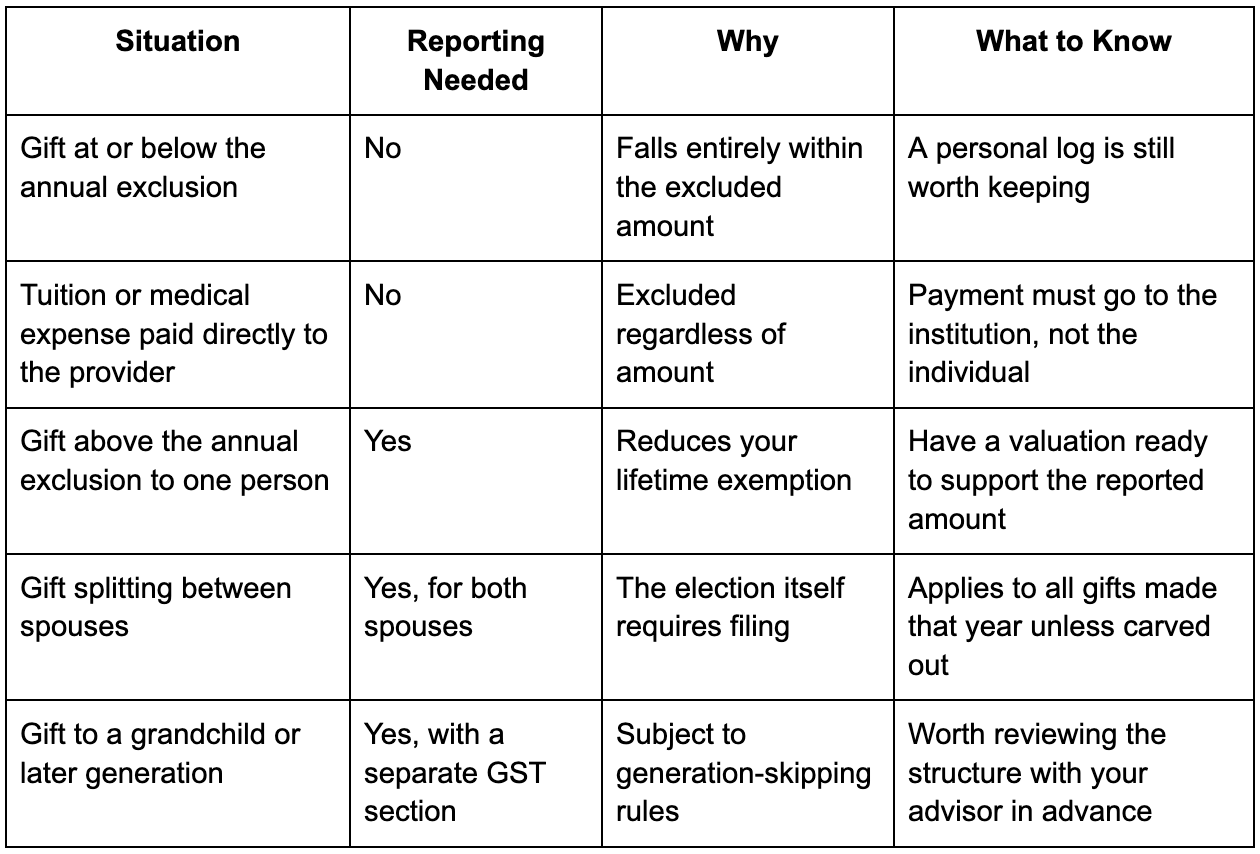
If a gift you're considering lands in one of the "yes" rows, it's worth a conversation with WealthPartners before the transfer happens rather than after.
Building a Paper Trail You Won't Regret Later
The best time to document a gift is the day it happens, not the following March when you're trying to reconstruct it. A workable system usually includes:
Who received the gift and on what date
What was transferred, with account numbers for securities or brokerage assets
A valuation tied to the actual gift date, not an estimate from memory
Confirmation that the transfer went through: a wire confirmation, statement, or recorded deed
Any related paperwork, such as a signed loan forgiveness letter
For cash and marketable securities, this is usually straightforward; a brokerage statement from the gift date typically does the job. Real estate and closely held business interests are a different story. Those generally call for a qualified appraisal, since "fair market value" isn't self-evident for illiquid or unique assets.
Timing It With Your Tax Return
Form 709 generally shares a deadline with your individual income tax return: April 15 of the year after the gift.³ If you file an extension for your Form 1040, it typically extends your Form 709 deadline as well. What it doesn't do is extend the time to pay any gift tax that might actually be owed, so if you suspect a filing might trigger tax, it's worth getting ahead of that separately.
A practical habit: keep your gift documentation in the same folder as your income tax records for that year. It saves your preparer time, and it gives your future executor a clean trail to follow.
An Annual Rhythm That Keeps This Simple
Log each gift as it happens throughout the year, not retroactively
Attach supporting documents (statements, appraisals) at the time of the gift
Reconcile the log against bank and brokerage records in early January
Determine by February whether a filing is required for the prior year
Flag any gaps in documentation to your preparer well before April
File for an extension if appraisals or signatures are still outstanding
Where People Tend to Trip Up
Assuming a simple gift doesn't need reporting. A single large check can cross the exclusion threshold without feeling like a "big" gift.
Forgetting the gift-splitting election. If splitting was the intent, skipping the paperwork can undo the strategy entirely.
Guessing at valuations. Especially for real estate or business interests, an unsupported number can invite questions later.
Reimbursing instead of paying directly. This quietly forfeits the tuition and medical exclusions.
Waiting until the deadline to start gathering records. Appraisals in particular can take longer than expected to arrange.
Where This Fits Into the Bigger Picture
Gifting doesn't happen in a vacuum. Every reported gift chips away at your lifetime exemption, which in turn affects how much runway your estate has later. That's worth keeping in mind if your gifting is part of a broader strategy, whether that's shrinking a taxable estate over time, equalizing what different heirs receive, or supporting a cause you care about while you're still around to see the impact.
Coordinating gifts with your trust documents, beneficiary designations, and overall estate plan helps make sure today's generosity doesn't create confusion for your executor down the line.
Frequently Asked Questions
If I file Form 709, does that mean I owe gift tax? Usually not. Most filings simply use up part of your lifetime exemption rather than generating an actual tax bill. Tax only becomes due once your cumulative taxable gifts exceed that exemption.
My spouse and I want to split a gift. Do we both have to file? Generally, yes. The election requires both spouses to file their own Form 709 for that year, and the returns should be consistent with each other.
I gave several people small amounts. Do I need to file anything? If each individual gift stayed at or below the annual exclusion, no filing is typically required. It's still a good idea to keep a personal record for your own files.
What's the right way to pay for a grandchild's tuition without triggering reporting? Pay the school directly rather than giving the money to the student or their parent. That direct-payment structure is what keeps the exclusion intact.
What should I have on hand if I do need to file? A dated list of recipients, valuations tied to the gift date, proof that the transfer occurred, and any related agreements, like a loan forgiveness letter. Keep it together as one packet.
Can I get more time to file? Generally, yes. Extending your individual income tax return typically extends your Form 709 deadline, too, though it doesn't extend any tax payment deadline.
Does gifting during my lifetime actually help reduce estate taxes later? It can be part of that strategy, but the benefit depends heavily on your specific situation and how it's structured. This is a good one to work through with your tax and legal professionals rather than assume.
Making Gifting Part of the Plan, Not an Afterthought
Sharing assets during your lifetime, rather than only through your estate, can be a meaningful way to support the people and causes you care about. Form 709 is simply the mechanism the IRS uses to keep track of that generosity when it crosses certain thresholds.
A few things worth remembering:
Most gifts never require a filing at all
A filing requirement doesn't mean a tax payment is coming
Direct payments for tuition and medical care stay outside the system entirely
Good records, gathered as you go, make everything downstream easier
If you're weighing a gift that might cross these lines, or you'd like to build gifting into your broader retirement and estate plan, contact WealthPartners to talk through what makes sense for your situation.
¹ IRS, Frequently Asked Questions on Gift Taxes: https://www.irs.gov/businesses/small-businesses-self-employed/frequently-asked-questions-on-gift-taxes ² IRS, Instructions for Form 709: https://www.irs.gov/instructions/i709 ³ IRS, What's New, Estate and Gift Tax: https://www.irs.gov/businesses/small-businesses-self-employed/whats-new-estate-and-gift-tax
This content is developed from sources believed to be providing accurate information. The information in this material is not intended as tax or legal advice. Please consult legal or tax professionals for specific information regarding your individual situation.
Securities offered through Kestra Investment Services, LLC, member FINRA/SIPC (Kestra IS). Investment advisory services offered through Kestra Advisory Services, LLC (Kestra AS). WealthPartners, Bluespring Wealth Partners, LLC, Kestra IS and Kestra AS are affiliated through common ownership by Kestra Holdings. WealthPartners is a member of PartnersFinancial. Kestra IS and Kestra AS are not affiliated with PartnersFinancial.
Kestra AS and Kestra IS do not provide tax or legal advice and are not Certified Public Accounting (CPA) firms.